By Faizan Saeed
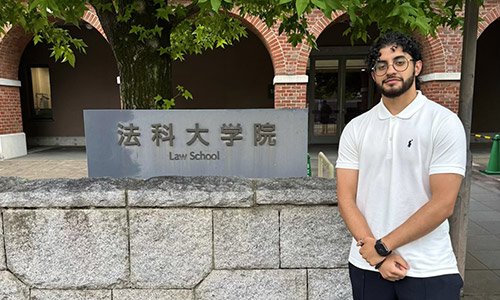
When I decided to study international business law in Japan this summer, I expected to deepen my understanding of how business transactions and legal disputes operate across borders. What I did not anticipate was how much I would learn beyond the classroom, from the people I met, the cultures I experienced, and the perspectives I gained.
Through Michigan State University College of Law’s study abroad program, I studied at Doshisha University Law School in Kyoto, Japan, while earning law school credit. Doshisha, a renowned historic institution, offered an extraordinary setting to explore the international dimensions of the law.
My academic journey has already taken me from the University of Toronto in Canada, where I earned my Honours Bachelor of Arts, to MSU Law in the United States, where I am pursuing my Juris Doctor (J.D.) degree. Studying in Japan added another dimension to that journey.
My coursework focused on international business law. I studied International Business Transactions under Professor Christopher Cherry, an accomplished U.S. corporate attorney based in Singapore, who brought practical perspectives to our discussions. In International Commercial Arbitration and Litigation, I learned from Professor Koji Takahashi, a distinguished Japanese legal scholar with extensive expertise in international dispute resolution.
Together, these courses broadened my understanding of cross-border business challenges and reinforced an important lesson: practicing law in an increasingly interconnected world requires more than understanding one’s own legal system. It requires an appreciation of how different legal traditions, commercial practices, and approaches to dispute resolution interact.
I was particularly proud to earn an A+, the highest possible grade, in both courses, as well as the Jurisprudence Achievement Award, which recognizes exceptional academic performance in law courses. These accomplishments were meaningful because I challenged myself academically while learning from scholars and practitioners whose experiences extended beyond the legal systems I had previously studied.
What surprised me was how well that academic commitment fit alongside everything else. Professor Frank Ravitch led school-organized field trips, and we gathered for program dinners and other shared experiences. We also had time to explore independently. I expected to have to choose between making the most of my coursework and experiencing Japan, but the program made room for both.
The program brought together law students from across the United States and Japan to exchange ideas, share experiences, and form long-lasting friendships across borders and cultures. I also had the privilege of connecting with accomplished attorneys and legal professionals from Japan and across Asia, including practitioners whose work and advocacy before Japan’s highest courts have helped shape Japanese law.
Their work deepened my appreciation for the diversity of the legal profession and how lawyers shape the law. Those conversations offered perspectives that no textbook alone could provide.

Beyond these academic and professional opportunities, I explored an extraordinary part of the world. Kyoto’s historic temples and traditions provided a fascinating contrast to the energy and modernity I experienced in Tokyo and Osaka. I also visited Japan’s quieter countryside and even traveled to Seoul, South Korea.
As a second-generation Pakistani who was born and raised in the West, with family living across different parts of the world, I found that experiencing East Asia for the first time offered yet another opportunity to appreciate different cultures and perspectives.
These experiences reminded me that education abroad means more than studying in another country. It means stepping outside familiar environments, approaching differences with curiosity, and developing a deeper understanding of the people behind the legal systems we study. For someone interested in international business and corporate law, these lessons carry particular significance. Business relationships and legal disputes may be governed by contracts and laws, but they also involve people whose perspectives are shaped by different cultures, values, experiences, and expectations.
I am grateful to Professor Ravitch for leading the program and to MSU Law for making it possible through its longstanding Doshisha partnership. From advocacy competitions across the U.S. to studying abroad in Japan, MSU Law has offered opportunities to learn beyond the classroom. The program reflects MSU’s broader commitment to education abroad, connecting me with distinguished scholars and practitioners and fostering lasting professional relationships.
As I move forward in my final year at MSU College of Law, I carry with me not only a stronger interest in international business and corporate law, but also a broader understanding of what it means to be part of a global village where the legal profession transcends cultures, jurisdictions, and borders.
I came to Japan hoping to deepen my understanding of international business law. I returned with something equally valuable: a greater appreciation for the people, cultures, and perspectives that shape how law is developed and practiced around the world. It is a lesson I hope to carry with me throughout my legal career.