For students just beginning law school, the term “access to justice” may be difficult to define. But during Foundations Week, the incoming class at Michigan State University College of Law witnessed what it means in someone’s life.
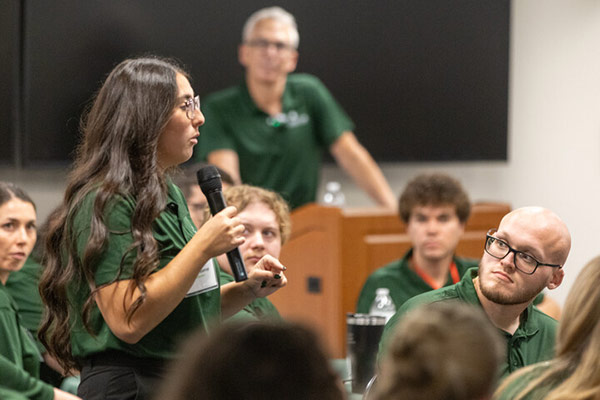
As part of their orientation, Aug. 24 through Aug. 28, 2026, the class of 2029 fanned out across Lansing, visiting locations that offer legal services to all, regardless of one’s ability to pay.
They returned with an appreciation of a system that helps those facing challenges related to immigration, income, housing, family, and more.
“Before our access to justice day, I thought of it as a way to help under-privileged people obtain adequate representation to get the rights they deserve,” said Seth Henry, ’29, of Fenton, Michigan. “But I learned it goes much deeper than this.”
At the 30th Circuit Court, Henry said he saw access to justice in action when the court provided a translator to defendant whose first language is not English.
“How unfair it would have been for the court to discuss this man’s future without him understanding what was being said,” he said. “Adequate representation for all is the only way to make sure everyone in our country has the same opportunity for growth and justice.”
Connor Franco, ’29, Jacksonville, Fla., agreed. He too visited the 30th Circuit Court and learned that “access to legal representation protects your best interests alongside the interests of your community.”
The students visited the Michigan Supreme Court, Michigan Legal Self-Help Center, ACLU of Michigan, Refugee Development Center, Tri-County Office on Aging, State Appellate Defender Office and Michigan Indigent Defense Commission, Legislative Services Bureau, 30th Circuit Court and Ingham County Prosecutor's Office.
While incoming students spend much of their first year learning the fundamentals of the law, as 2Ls and 3Ls they can participate in experiential learning opportunities – all of which relate to providing justice to the most vulnerable.
It’s no accident these programs mirror MSU’s Access to Justice Day, said Dean Michael Sant’Ambrogio.
“We are in a service profession,” he said. “Our students learn from the beginning of their legal education that the law doesn’t exist only in casebooks and classrooms. It exists in people’s lives. And through our experiential learning programs, they work hard to change those lives for the better.”
The College’s eight clinics, five centers, and three institutes focus on areas of the law related to housing, immigration, Indian law, tax burdens, child advocacy, First Amendment and public defense, intellectual property, technology, human rights, and trial practice. Clinics, Centers, Institutes
Access to justice can mean helping someone understand a legal process they would otherwise have to navigate alone. It can mean protecting a tenant from losing housing, helping an immigrant seek lawful status, advocating for a taxpayer overwhelmed by debt, defending the constitutional rights of someone facing criminal charges or protecting the legal rights of tribal communities.
From their first week of law school to graduation day, MSU Law students experience justice in action – whether they intern in the state’s highest court, a prosecutor’s office or a public defender’s office or provide pro bono work in civil-rights organizations.
At MSU Law, students are not simply being introduced to where lawyers work. They learn why the work matters.